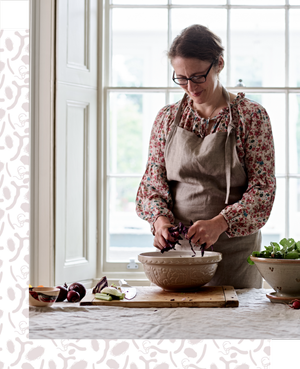
Meet Rose Whitehouse
World Ferment Day Ambassador for England
Head fermenter for Shillingford Organics, educator via Red Earth Ferments and supporter of local food systems, Rose Whitehouse shares her ferment journey and her passion for all things fermented.
What led you to fermentation, and when did your journey begin?
I'm Rose Whitehouse. I am from Aotearoa, New Zealand, but I've been living in Devon, UK for quite some time now. I'm the World Ferment Day ambassador for England, UK. I work on a farm called Shillingford Organics, where we take vegetables from the fields and we ferment them back at the production kitchen. I also run education and teach workshops around fermenting and have done for many years through Red Earth Ferments. I first began fermenting around 2010, just after my first child was born. I had previously been diagnosed with celiac disease and I was looking for ways to improve my health. As a lot of fermenters end up getting into fermenting through their health journeys, that was me.
I became absolutely fascinated with fermenting. It was such an easy process, but it had such amazing results and I was absolutely hooked. When I started working out on this farm, I changed my approach to fermenting in a different way. I developed a deeper connection with how food is growing and it turned into something much bigger. Because I was able to take food from the farm and see how it was growing and take it straight into the kitchen that day and ferment it, I could see the real difference between using local food and food that was locally sourced and organic. I could just see the difference in energy that food gave the ferments. Fermenting for me is something much bigger. It's a way of connecting with our food, the seasons and the invisible microbial world around us.
What motivates you to continue fermenting?
Well, fermenting is part of me now. I love that it teaches us patience and observation. I love that we can take the same recipe and we can follow the same practices and depending on the season and depending on where the veg came from, we can get differences in flavour and results. I love that it leads to less waste in food and I love that it helps us to celebrate seasonal abundance. I love sharing it with people and I love teaching it to other people so that they can see how easy it is to make for themselves. They go home and give me feedback about how they've noticed a difference in their digestion or their whole way of looking at where our food comes from. It just delights me and it's so, so delicious.
What was your first fermentation experience?
My first fermentation experience came through milk kefir, even though I mostly deal in the world of vegetable fermentation. It was back when my son was a tiny baby and I was taking him to La Leche League and in the theme of milk, somebody, one of the mothers there, gave me some milk kefir grains and suggested to me that it might help my digestion. I started fermenting it and was just blown away by how easy it was and yes, slowly I did notice the difference in my body.
What is an easy way to introduce ferments to someone who has never tried them?
A great way to start fermenting if you've never tried it is to start with something really simple. Don't go for the really complicated stuff, don't go for a recipe that's got a million ingredients. You want to just start with the basics. So I started with milk kefir. It was as simple as putting grains in some milk and leaving it to ferment and then straining it out. You can then blend it up with some fruit and drink it like a smoothie. Or you could start with a very simple brine ferment. Take something like radishes and create a salt brine for them to ferment in and then that's an amazing, delicious way of just having a little morsel of fermented condiment on your plate. You could then move on to something like sauerkraut, but just stick to a simple one like salt cabbage and then start to work on flavours as you start to feel more confident.
How does fermentation fit into your life?
How does fermentation fit into my life? It's woven into almost every part of my life. I run Red Earth Ferments, where I teach fermentation. I'm the head fermenter for Schilling Food Organics, so I make ferments on a regular basis. I'm bottling up ferments weekly and getting to taste them all the time. But as I've mentioned before, it's a way of connecting us into the seasons. So beyond my actual daily work of making ferments itself, the way I am engaging in the vegetables is a way of noticing the seasons we're living in.
To me, it reminds us to preserve abundance and to respect the natural processes. So we see a cabbage and we think, how could I turn this into something that I could ferment? I see carrots and I think, what could I do to ferment those? And I absolutely delight in taking something that is just there for a snapshot of the season. And then knowing that we will have this flavour for months and months to come. And it's sort of like a memory that gets locked into us and of that moment in time. And so something that we could ferment now would remind us of summer. It's like trapping summer in a jar.
Which ferment or ferments did you eat/drink most recently?
The ferment that I would eat and drink most regularly would be hands-down sauerkraut. It's largely to do with how I'm working. I'm working in a production kitchen and I'm having to taste test batches before we bottle them up. So I'm always just grabbing a little bit here and there and tasting them. I do drink quite a lot of milk café, as I've already talked about. And in summer, I tend to drink a lot of fermented sodas, so water café or something made with wild yeast, like a ginger bug. But the main thing I like to think about is diversity. So it's not about taking a whole jar and just gobbling it down. It's about range. And it's about how, you know, so having quite a few different ferments in your fridge at a time, going with your body on what you're wanting to eat and just changing up what you're eating. So this morning for breakfast, I had some eggs with kimchi. But on another day, I might have had it with this beetroot kraut. Or for lunch, I might enjoy wild garlic buds.
So fermentation for me is a reminder that we're not really making food on our own. We're collaborating with millions of microorganisms. And there is something so deeply hopeful moving forward in empowering people to take control of their local food systems and to take control of their own food production so that we can nourish ourselves and not have to rely on the bigger systems around us to support us. I hope you are having an absolutely wonderful sunny day like we are having in Devon, and I wish you all the best on your fermentation journey.